
A Unified AI Framework: How the U.S. Executive Order Sets a New Standard for Innovation
President Trump’s 2025 executive order on artificial intelligence establishes a single national regulatory framework to replace conflicting state laws — a move designed to streamline innovation, safeguard competitiveness, and ensure the U.S. leads in global AI development.
National Leadership for a Transformative Era
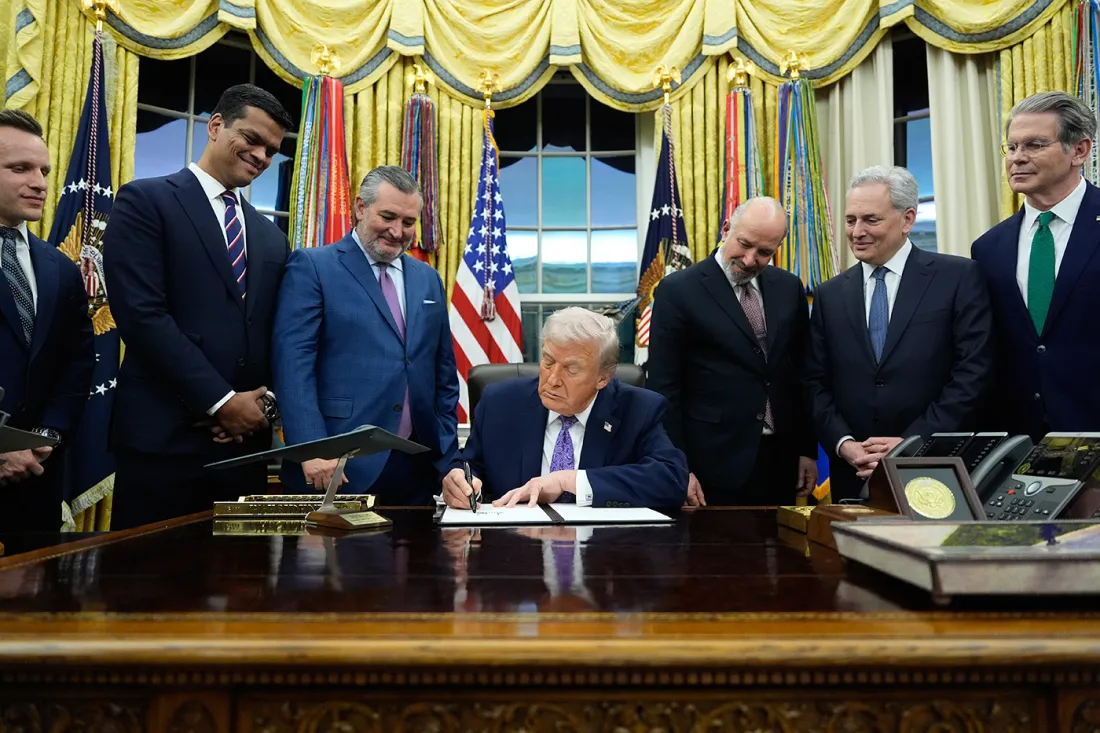
On December 11, 2025, President Donald Trump signed an executive order that redefines America’s approach to artificial intelligence. The measure, titled “Ensuring a National Policy Framework for Artificial Intelligence”, establishes a single, federally guided system for AI oversight — replacing the fragmented patchwork of state regulations that had begun to emerge across the country.
As reported by PBS, CNBC, and Politico, the order empowers federal agencies to coordinate under one unified strategy, preventing conflicting local regulations that could slow innovation or confuse compliance requirements. It’s a decisive step toward giving American innovators clarity, consistency, and confidence in deploying AI responsibly.
Ending the Patchwork: Why a Single Framework Was Necessary
Artificial intelligence operates beyond geographical boundaries. Models trained in California may power logistics in Texas, healthcare analytics in New York, or defense planning in Virginia. Before this executive order, several states were pursuing independent AI laws — each with unique definitions of “responsible use” and “data transparency.”
That fragmentation created uncertainty for companies and investors. By centralizing authority at the federal level, the new framework ensures consistency, efficiency, and national competitiveness — allowing developers to innovate without navigating fifty sets of compliance rules.
This unified system mirrors global trends: while the EU pursues the AI Act and Asia invests in cohesive national standards, the United States now brings its own centralized structure — one that emphasizes innovation over restriction.
Driving Innovation Without Overregulation
According to Colorado Public Radio, the order’s central goal is to prevent “cumbersome and overlapping” AI laws at the state level. Overregulation, the administration argues, risks stifling start-ups and discouraging private investment in key sectors like robotics, healthcare, and advanced manufacturing.
Instead, the executive order establishes a minimally burdensome national standard — one that keeps regulatory barriers light but predictable. This balanced approach encourages innovation while preserving accountability, allowing American AI firms to remain competitive globally.
“When rules are clear, innovation accelerates,” said a senior White House official. “This framework provides certainty for developers and protection for citizens — two sides of the same coin.”
Clarity Builds Confidence for Businesses and Consumers
Predictability is power. A unified national framework allows companies to operate seamlessly across all fifty states, reducing legal costs and accelerating product deployment. For consumers, it provides peace of mind — ensuring that AI systems follow consistent federal standards for privacy, safety, and transparency no matter where they are used.
This model also streamlines compliance for multinational corporations, allowing them to align domestic operations with international standards more easily, fostering global trust in U.S. AI products and practices.
Boosting U.S. Competitiveness in the Global AI Race
The global AI economy is projected to exceed $2 trillion by 2030. In that race, cohesive governance is as crucial as innovation itself. The executive order positions the United States to lead by ensuring that its AI strategy is unified, adaptable, and nationally coordinated.
Fragmented policy would have slowed research and discouraged investment. A national framework, by contrast, empowers federal agencies to align research funding, workforce development, and international cooperation. In effect, this policy acts as an industrial roadmap for the digital age — designed to accelerate, not obstruct.
Responsible AI, Not Unchecked Power
While the executive order prioritizes innovation, it equally emphasizes responsibility. The policy calls for coordination among agencies such as the Federal Trade Commission, Department of Commerce, and National Institute of Standards and Technology to develop ethical guidelines and public accountability standards for AI systems.
These agencies are tasked with defining rules for algorithmic fairness, data transparency, and model explainability. Rather than enforcing heavy restrictions, the order promotes what the administration describes as a “trustworthy innovation ecosystem” — one where accountability is integrated from design to deployment.
The AI Litigation Task Force and Federal Oversight
To ensure consistent application, the order creates a new AI Litigation Task Force within the Department of Justice. Its mission: challenge state-level laws that conflict with federal AI policy. Though some critics argue it may face legal tests, the administration views this task force as essential to maintaining national cohesion and preventing regulatory fragmentation.
As Politico notes, the order reinforces federal jurisdiction over interstate technology and commerce — asserting that AI’s role in national competitiveness warrants unified oversight similar to that of telecommunications or aviation.
Economic Growth Through Certainty
For investors and innovators, stability breeds confidence. The order’s most immediate impact is economic — encouraging long-term investment in AI by providing a clear regulatory environment. Venture capital activity, manufacturing automation, and AI integration across industries are expected to accelerate as a result.
Businesses can now plan multi-year AI strategies knowing that legal conditions won’t shift abruptly at the state level. In essence, the U.S. has declared: it’s open for AI business.
Workforce and Education Implications
As AI adoption expands, so will the need for skilled professionals in data science, machine learning, AI safety, and digital ethics. The unified framework gives educational institutions and employers a consistent national standard to design programs and certifications around — aligning training with industry demand.
Toward a Federal AI Act
The order also lays the groundwork for comprehensive congressional legislation. By calling on lawmakers to codify a long-term AI policy, it establishes the foundation for a future Federal AI Act — one that could define the next generation of American technological leadership.
Such legislation would enshrine the principles of responsible AI use, transparency, and innovation — providing enduring policy continuity as AI evolves.
Conclusion: The Right Decision at the Right Time
President Trump’s 2025 executive order represents a decisive pivot toward national unity in AI governance. It aligns the public and private sectors under one vision: to innovate boldly, act responsibly, and lead globally. By providing clarity, confidence, and consistency, the framework ensures that the U.S. remains not just a participant but a leader in shaping the future of artificial intelligence.
Interested in AI governance, compliance, and automation strategy? Connect with DGX Enterprise AI today.