
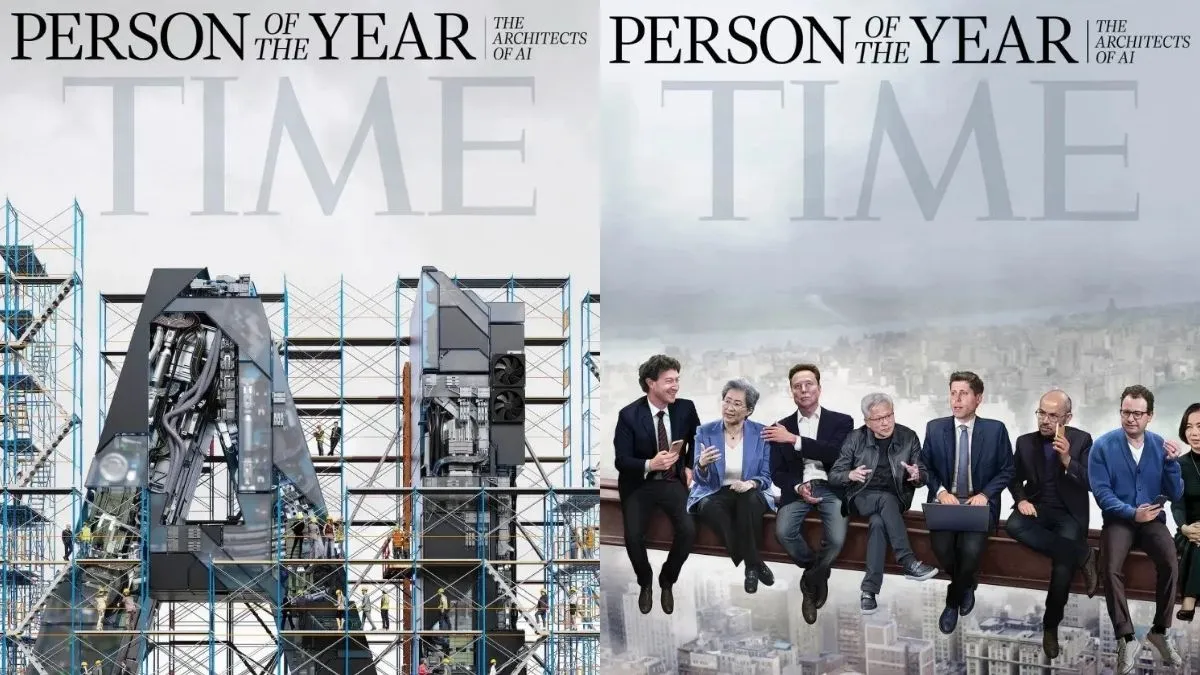
2025 Person of the Year: The Architects of AI
TIME Magazine names the “Architects of AI” as 2025 Person of the Year, celebrating the innovators shaping how humanity works, learns, and governs in the age of artificial intelligence.
In a landmark decision that captures the spirit of 2025, TIME Magazine named the “Architects of AI” as its Person of the Year — a collective of innovators whose technologies and leadership have reshaped how humanity creates, communicates, and governs in the digital era.
The award honors not one person, but a movement. As TIME noted, 2025 was the year artificial intelligence became an undeniable global force — powering businesses, redefining economies, and transforming everyday life.
Why This Matters: AI as a Defining Force in 2025
Artificial intelligence’s footprint expanded more rapidly in 2025 than in any prior year. Generative models, large language systems, and automation platforms reached billions of users across industries — from enterprise software to healthcare analytics. The Architects of AI distinction recognizes the individuals driving this transformation: engineers, researchers, and executives who have turned data into the world’s most valuable resource.
Among those recognized were Jensen Huang of Nvidia, Sam Altman of OpenAI, Demis Hassabis of Google DeepMind, Dario Amodei of Anthropic, Lisa Su of AMD, Fei-Fei Li of Stanford University, and Elon Musk of xAI. Collectively, they represent the technological vanguard — pioneers who built the infrastructure, models, and institutions defining the AI era.
AI’s Breakthroughs in 2025
TIME’s selection of the Architects of AI is more than symbolic. It highlights measurable, transformative impact across sectors. AI is no longer a futuristic concept — it is the backbone of innovation and productivity in the global economy.
1. Mass Adoption Across Industries
2025 saw AI integrated into nearly every professional sector. From manufacturing optimization and logistics forecasting to medical imaging and creative design, artificial intelligence became indispensable. AI-driven automation improved efficiency while reducing operational costs, reshaping both industrial and digital supply chains.
2. Economic and Infrastructure Expansion
The AI boom triggered unprecedented growth in infrastructure investment. Semiconductor production, data centers, and high-performance computing systems reached record scale. Nvidia, AMD, and Microsoft poured billions into global GPU clusters, while startups leveraged open models to democratize access to advanced AI capabilities. The ecosystem matured — robust, fast, and unrelenting in pace.
3. Cultural Influence and Debate
Beyond economics, AI became a cultural phenomenon. 2025 ignited public discourse around ethics, creativity, and control. Conversations about transparency, misinformation, and mental health highlighted the societal dimension of AI’s rise. While many hailed it as humanity’s greatest accelerator, others urged caution, emphasizing responsible deployment and human oversight.
The Architects of AI: Why This Choice Breaks Tradition
In a historic move, TIME shifted focus from politics and celebrity to technology and collaboration. Traditionally, the Person of the Year has recognized singular influence — from presidents and activists to innovators and movements. The 2025 choice acknowledges a collective, decentralized leadership model: a global alliance of visionaries shaping the digital frontier.
The magazine’s editors described their decision as a recognition of “those who built the new world’s operating system.” These leaders did not just create code; they redefined the parameters of progress.
Leadership, Competition, and Global Stakes
According to BBC News and USA Today, the selection underscores how AI leadership has become a geopolitical priority. Governments and private sectors alike are investing heavily in AI infrastructure, regulation, and defense applications. The global race to master AI mirrors the 20th-century space race — only this time, the competition is measured in data, algorithms, and compute power.
In the United States, the Biden and Trump administrations alike have positioned AI as central to national security and innovation policy. Across Europe and Asia, new regulatory frameworks and public-private partnerships continue to emerge. The architects recognized by TIME are not merely technologists — they are policy shapers, cultural figures, and economic architects influencing how societies evolve.
The Human Factor Behind Machine Intelligence
AI’s advancement has sparked a profound philosophical question: what remains uniquely human in an age of intelligent machines? The 2025 honorees have often acknowledged this tension. Fei-Fei Li continues to advocate for “human-centered AI,” emphasizing empathy, inclusivity, and education. OpenAI’s leadership stresses the need for transparent governance and public participation in AI oversight. Nvidia’s Jensen Huang reminds the world that every great leap in computing is ultimately about empowering creativity, not replacing it.
These perspectives reveal an evolving ethos — one where technological innovation and ethical responsibility must advance together. The future of AI is not automation alone; it is augmentation, collaboration, and shared progress.
What Comes Next
The Architects of AI story is still unfolding. As nations standardize regulations and industries redefine roles, the question is no longer whether AI will shape our future — but how wisely we’ll direct its power. With growing calls for oversight, transparency, and international cooperation, 2026 will likely be remembered as the year when the governance of AI becomes as important as its creation.
For business leaders, researchers, and policymakers, this recognition is both inspiration and challenge: to innovate boldly while maintaining the integrity and trust that make progress sustainable.
Conclusion: The Era of the Architects
TIME’s 2025 Person of the Year captures more than a headline — it defines an era. The Architects of AI represent a shift in civilization’s trajectory, from analog industry to intelligent infrastructure. Their work bridges code and culture, innovation and responsibility, speed and foresight.
Artificial intelligence has moved from the margins of research to the center of global transformation. And behind that transformation stand the architects — the visionaries building the neural foundations of the future.
Interested in enterprise AI solutions, strategy, or automation design? Connect with DGX Enterprise AI today.