
China’s Multi-Track BCI Strategy: Implants, Wearables, and Ultrasound
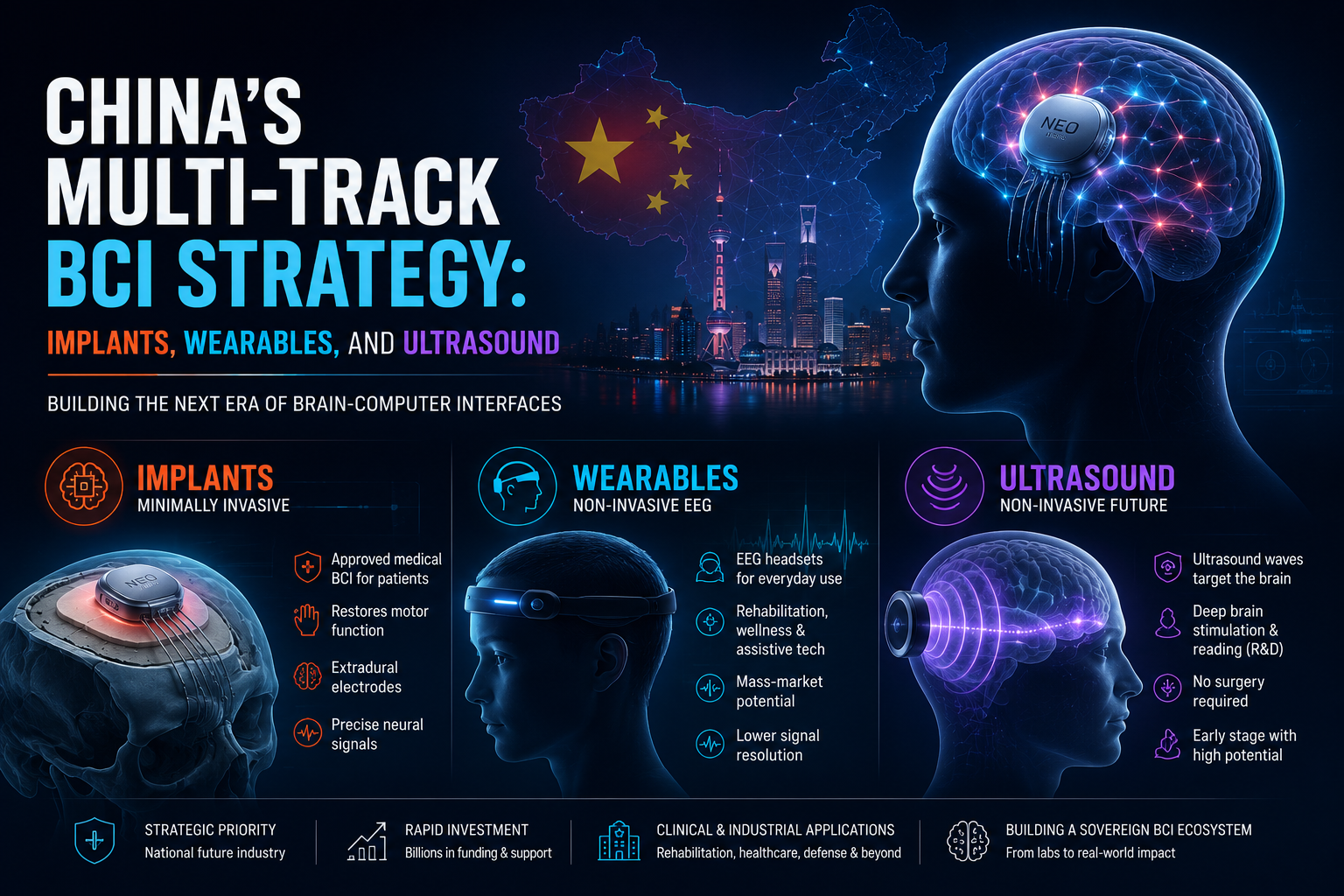
China is advancing brain-computer interfaces through several parallel paths, including commercially approved medical implants, wearable EEG systems, and experimental ultrasound platforms. The result is not one direct Neuralink rival, but a coordinated strategy to build an entire neurotechnology industry.
A Breakthrough That Needs the Right Context
China’s recent progress in brain-computer interfaces has generated headlines suggesting that the country has found a way to compete with Neuralink without opening the skull. The reality is more complex, and ultimately more significant.
China has not produced one non-invasive device that matches the performance of a high-resolution cortical implant. Instead, it is advancing several BCI architectures at the same time. These include implanted medical systems, minimally invasive devices placed near the brain, wearable electroencephalography platforms, and experimental ultrasound interfaces.
This multi-track strategy reflects a broader industrial approach. Rather than betting the entire market on one technological path, China is creating a portfolio that can address different levels of clinical need, signal quality, cost, safety, and consumer acceptance.
The most important development so far is not a science-fiction mind-reading headset. It is a commercially approved medical device that helps patients with severe paralysis recover limited hand function through a robotic glove.
The NEO Approval Marks a Global First
On March 13, 2026, Chinese regulators approved the commercial launch of an implantable brain-computer interface designed for patients with quadriplegia caused by cervical spinal-cord injuries. The system, known as NEO, was developed by Neuracle Medical Technology in collaboration with researchers from Tsinghua University.
The device records neural activity associated with imagined hand movement. Those signals are transmitted to a computer, decoded, and converted into commands that control a powered glove. The system can help users perform basic grasping movements and interact with everyday objects.
This approval represents a major milestone because NEO became the first implantable BCI medical device authorized for commercial use outside a clinical-trial setting. Brain implants have been studied for decades, but moving from experimental research into an approved product is a very different achievement.
The breakthrough is narrow but practical. NEO is not a general-purpose computer interface. It is not designed for consumer entertainment or broad cognitive enhancement. It is a medical rehabilitation product built around a measurable outcome: restoring a degree of hand control to people with serious spinal injuries.
Why It Is Not Truly Non-Invasive
Some coverage has described NEO as a system that avoids drilling the skull. That description is misleading. The device still requires surgery and implantation. A small opening is made in the skull, and the coin-sized unit is positioned close to the brain’s motor region.
The key difference is where the electrodes sit. Neuralink uses flexible electrode threads that penetrate the cortex. NEO’s electrodes are positioned outside the brain tissue, near the dura mater. This reduces the degree of tissue penetration while still allowing the system to collect stronger neural signals than a conventional scalp-mounted headset.
That places NEO in a middle category. It is less invasive than a device that inserts electrodes deep into the cortex, but it is more invasive than EEG wearables that sit entirely outside the body.
The distinction matters because invasiveness directly affects signal quality, surgical risk, regulatory complexity, and market size. Systems located closer to the brain generally capture cleaner and more detailed signals. Systems located outside the skull are easier to adopt but must work with weaker and noisier data.
China Is Building a Portfolio, Not One Rival
The broader Chinese BCI sector includes companies and research programs pursuing multiple architectures. Some are building systems that resemble Neuralink more closely. Others are focusing on minimally invasive medical devices. A third group is developing wearable interfaces that could eventually reach much larger populations.
NeuCyber NeuroTech, a company connected to the Chinese Institute for Brain Research, is developing the Beinao platform. One version uses a mesh of electrodes positioned on the brain’s outer membrane. A more advanced version is intended to place flexible electrodes inside brain tissue.
NeuCyber has acknowledged that its most advanced system remains several years behind Neuralink. That admission is important because it illustrates the difference between commercial leadership and technical leadership. China may have achieved the first commercial approval for a narrowly defined medical implant, while Neuralink remains further ahead in high-channel-count cortical interfaces and robotic electrode insertion.
China’s strategy does not require every company to beat Neuralink at the same task. It allows different systems to compete in different segments.
Wearable EEG Could Be the Larger Market
Non-invasive EEG devices represent the largest share of China’s current clinical research activity. These systems use electrodes placed on the scalp to measure electrical patterns generated by the brain.
EEG interfaces already have potential applications in stroke rehabilitation, prosthetic control, attention tracking, communication support, wellness products, and assistive technology. They avoid surgery, cost less to deploy, and can be manufactured in familiar forms such as headbands, caps, glasses, and ear-mounted devices.
The tradeoff is signal resolution. The skull and surrounding tissue weaken and distort neural activity before it reaches the electrodes. AI can help filter noise, recognize individual patterns, and improve decoding, but software cannot completely remove the physical limits of distance and tissue interference.
Even with that limitation, wearable systems could become the larger commercial market. Most consumers will never volunteer for brain surgery to control a computer. They may, however, wear a lightweight headset if it provides useful rehabilitation, accessibility, productivity, gaming, or wellness functions.
This is where China’s manufacturing scale could become an important advantage. If EEG systems become effective enough for everyday use, China has the supply chains, electronics expertise, and domestic market needed to lower costs rapidly.
Ultrasound Is the Most Experimental Path
A more speculative branch of China’s BCI ecosystem is focused on ultrasound. Companies such as Gestala are investigating whether focused ultrasound can interact with deeper regions of the brain without implanted electrodes.
Ultrasound is attractive because it can travel through tissue and potentially reach areas that are difficult to access with surface electrical stimulation. It may support applications in chronic-pain treatment, neural stimulation, and eventually brain-signal interpretation.
The challenge is substantial. The skull distorts ultrasound waves, and reading detailed neural activity through bone remains technically difficult. Current ultrasound systems are better understood as an emerging research platform than as a proven replacement for implanted BCIs.
Still, the long-term potential is considerable. A system capable of reaching deep neural structures without surgery could open entirely new medical and consumer markets. That possibility explains why China is investing in the category even though commercialization remains distant.
The Clinical Pipeline Is Expanding Quickly
A July 2026 landscape analysis identified 134 registered BCI clinical trials in China, along with 26 investigator-initiated studies and five BCI-related products that had received regulatory approval by June 2026.
Non-invasive systems accounted for approximately 79% of the registered studies. Stroke rehabilitation was the leading indication, representing about 65% of the trial landscape.
Those numbers help clarify where the sector is actually focused. China’s BCI industry is currently driven more by rehabilitation and medical restoration than by consumer telepathy or cognitive enhancement.
This is a practical starting point. Medical applications offer clear patient needs, measurable outcomes, structured clinical environments, and a stronger justification for surgical risk. A person with severe paralysis may accept an implant if it restores communication or movement. A healthy consumer faces a very different risk-benefit calculation.
Government Policy Is Accelerating Commercialization
China has formally designated brain-computer interfaces as a strategic future industry. A national implementation plan coordinated by seven government ministries calls for breakthroughs in electrodes, chips, integrated devices, software, standards, medical applications, and industrial deployment.
The roadmap targets major technical progress by 2027 and a mature, internationally competitive industrial ecosystem by 2030. It also calls for the development of two or three globally influential companies, supported by specialized suppliers and regional industrial clusters.
This policy structure gives Chinese companies access to something more powerful than isolated research funding. It connects laboratories, hospitals, regulators, investors, manufacturers, local governments, and national standards into a coordinated development pipeline.
Shanghai is already building a dedicated BCI cluster that combines startups, medical institutions, clinical laboratories, and investment mechanisms. Other regions are creating their own programs around neurotechnology research, manufacturing, and commercialization.
This coordinated structure may become China’s strongest competitive advantage. The country is treating BCI as an industry that must be engineered from research through mass production.
China and Neuralink Are Optimizing for Different Goals
Comparisons with Neuralink are inevitable, but the two strategies currently emphasize different priorities. Neuralink is pursuing high-resolution invasive interfaces capable of computer control, communication, and eventually broader interaction with digital systems. Its robotic surgical platform and flexible cortical threads remain major technical advantages.
China’s emerging ecosystem is broader. It includes fully invasive systems, minimally invasive clinical products, non-invasive rehabilitation equipment, and experimental consumer-facing technologies.
Neuralink may lead in sophisticated cortical interfaces. China may lead in building a diversified commercialization pipeline that reaches hospitals and rehabilitation markets sooner.
The outcome may not be one winner. Different BCI architectures may serve different needs. High-resolution implants may remain appropriate for severe medical conditions. Minimally invasive systems may offer a middle ground. Wearables may dominate lower-risk consumer and rehabilitation applications.
The Economic Opportunity Extends Beyond Medicine
Healthcare will likely remain the first major market, but China’s policy ambitions extend further. Future applications could include industrial safety, driver monitoring, human-machine control, education, gaming, workplace fatigue detection, and integration with robotics.
Non-invasive devices may eventually be tested in hazardous sectors such as mining, energy, nuclear operations, and advanced manufacturing. In these environments, neural and physiological monitoring could help detect fatigue, distraction, or cognitive overload.
Longer term, BCIs could become part of a wider human-machine interface economy. AI systems would decode noisy neural patterns, robotics would execute commands, and edge-computing platforms would process signals in real time.
That future remains uncertain, but China is clearly building the technical and industrial foundation needed to compete if the market develops.
Final Perspective
China has not produced a non-invasive system that has already surpassed Neuralink. That framing oversimplifies the technology and misses the more important development.
The country is building a multi-track BCI industry. Commercial implants address urgent medical needs. Minimally invasive systems balance signal quality with reduced tissue penetration. Wearable EEG devices offer a path toward scale. Ultrasound research represents a longer-term bet on truly non-invasive access to deeper brain regions.
The NEO approval proves that China can move a BCI from clinical testing into authorized medical use. The trial pipeline shows that the ecosystem is expanding. The national roadmap shows that commercialization is not being left to chance.
The global BCI race will not be decided by one device or one headline. It will be shaped by clinical outcomes, manufacturing economics, regulatory speed, signal quality, user acceptance, and the ability to build complete industrial ecosystems.
China’s advantage may not be that it has found one perfect route. Its advantage may be that it is pursuing all of them at once.