
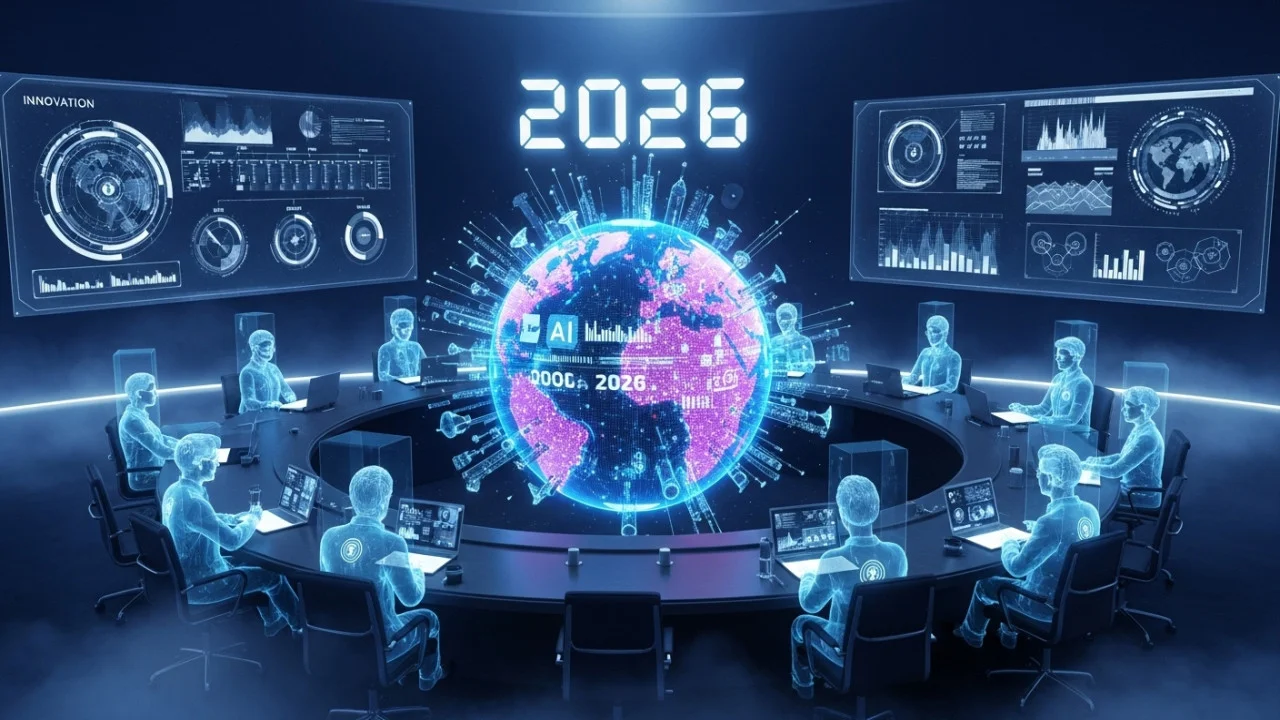
AI in 2026: From Intelligent Tools to Global Infrastructure
As artificial intelligence moves into its next phase, 2026 is shaping up to be the year AI transitions from experimental tools to foundational infrastructure. Insights from Microsoft, Oxford researchers, and enterprise analysts reveal how AI will reshape work, media, and decision-making at scale.
AI in 2026: From Intelligent Tools to Global Infrastructure
By DGX Enterprise AI Team – January 11, 2026
A Turning Point for Artificial Intelligence
For more than a decade, artificial intelligence has evolved in waves—first as automation, then as prediction, and most recently as generative capability. By the start of 2026, it has become clear that AI is entering a fundamentally new phase. According to technology leaders, enterprise analysts, and academic researchers, the coming year will not be defined by bigger models alone, but by how deeply intelligence becomes embedded into the world’s digital and physical systems.
Microsoft describes this transition as the moment AI moves from “assistive software” to foundational infrastructure. Much like cloud computing a decade earlier, AI is no longer a feature—it is becoming the invisible layer that underpins productivity, communication, and decision-making across nearly every industry.
From Copilots to Autonomous Systems
One of the clearest trends shaping 2026 is the shift from reactive AI tools to proactive, autonomous systems. Early copilots responded to prompts. The next generation plans, executes, and adapts. Enterprise AI systems are increasingly capable of monitoring environments, triggering actions, and coordinating across applications without constant human input.
VentureBeat’s analysis of enterprise data trends highlights this evolution clearly: organizations are moving away from single-purpose AI deployments toward agent-based architectures. These systems consist of multiple specialized agents—each responsible for tasks such as data ingestion, reasoning, validation, and execution—working together in real time.
The implication is profound. AI is no longer just helping people work faster; it is beginning to operate as a digital workforce—one that never sleeps, learns continuously, and scales instantly.
AI Becomes a Decision Layer
In 2026, AI will increasingly sit between raw data and executive decision-making. Rather than presenting dashboards or static reports, AI systems will interpret signals, weigh tradeoffs, and recommend actions within defined governance boundaries.
Microsoft identifies this as the rise of AI as a reasoning layer. These systems do not replace leadership, but they dramatically narrow uncertainty. Whether forecasting supply chain disruptions, modeling workforce needs, or optimizing pricing strategies, AI will function as a continuously updating intelligence layer across the enterprise.
This shift requires a new relationship between humans and machines—one where trust, transparency, and oversight are designed into systems from the beginning.
The Enterprise Data Reckoning
According to VentureBeat, one of the most significant challenges enterprises face in 2026 is not model capability, but data readiness. Years of siloed systems, inconsistent schemas, and ungoverned data lakes have limited AI’s effectiveness.
As a result, organizations are prioritizing data architecture modernization. Clean pipelines, real-time data access, and strong metadata management are now prerequisites for competitive AI deployment. The companies that invested early in data foundations are pulling ahead—while those that treated AI as a plug-and-play solution are struggling to scale.
AI’s success in 2026 will depend less on algorithms and more on how well enterprises organize, secure, and contextualize their information.
News, Media, and the Redefinition of Trust
The Reuters Institute at Oxford offers a critical perspective on how AI will reshape news and information ecosystems by 2026. Generative AI has already transformed content creation, but its deeper impact lies in distribution, verification, and personalization.
Media organizations are increasingly using AI to assist with investigative research, multilingual reporting, and audience engagement. At the same time, concerns around misinformation and synthetic media are forcing newsrooms to adopt stronger verification frameworks.
The consensus among experts is that AI will not replace journalism—but it will redefine credibility. News organizations that integrate AI responsibly, with transparency and editorial oversight, will strengthen trust. Those that fail to adapt risk losing relevance in an increasingly algorithm-driven information landscape.
Multimodal Intelligence Goes Mainstream
Another defining trend of 2026 is the normalization of multimodal AI. Systems that understand text, images, audio, video, and structured data simultaneously are no longer experimental—they are becoming standard.
ImagartAI and TechBoosted both point to multimodal capability as a catalyst for breakthroughs in education, healthcare, manufacturing, and design. AI systems can now analyze visual inspections while referencing technical manuals, interpret spoken instructions while reviewing sensor data, and generate insights that reflect real-world context.
This convergence of modalities enables AI to interact with the world more like humans do—through perception, reasoning, and communication combined.
AI and the Evolution of Work
Contrary to fears of mass displacement, expert forecasts suggest that AI in 2026 will continue to reshape work rather than eliminate it. The nature of roles is changing: repetitive cognitive tasks are increasingly automated, while human workers focus on strategy, creativity, and judgment.
Microsoft emphasizes the importance of AI literacy as a core skill. Employees are expected not just to use AI tools, but to supervise them—reviewing outputs, setting objectives, and intervening when necessary.
This transition places new demands on leadership. Organizations must invest in reskilling, redefine performance metrics, and design workflows that treat AI as a collaborator rather than a black box.
Responsible AI as a Competitive Advantage
By 2026, responsible AI is no longer a compliance checkbox—it is a differentiator. Enterprises that demonstrate fairness, explainability, and accountability in their AI systems are earning greater trust from customers, regulators, and partners.
Microsoft and Oxford researchers alike emphasize that governance frameworks are maturing. Model documentation, audit trails, and bias monitoring are becoming standard practice. Rather than slowing innovation, these safeguards are enabling organizations to deploy AI more confidently at scale.
Trust, once established, becomes a powerful accelerant.
AI as Infrastructure, Not Disruption
Perhaps the most important insight across all forecasts is this: AI in 2026 is no longer perceived primarily as a disruptive force. It is becoming infrastructure—embedded, reliable, and expected.
Like electricity or the internet, AI will fade into the background of daily operations. Its value will be measured not by novelty, but by consistency. Systems that quietly optimize logistics, personalize education, detect fraud, and support decision-making will define success.
The organizations that thrive will be those that stop asking what AI can do, and start asking how intelligence should flow through their systems.
The DGX Perspective: Designing Intelligence at Scale
At DGX Enterprise AI, we view 2026 as the year intelligence becomes intentional. The focus shifts from experimentation to architecture—from isolated use cases to cohesive systems.
Building for this future requires more than deploying models. It requires designing governance, data pipelines, human oversight, and integration strategies that allow AI to operate responsibly at scale.
The next era of AI will not be won by those who move fastest, but by those who build smartest—creating systems that are resilient, transparent, and aligned with human goals.
Looking to architect enterprise-grade AI systems for 2026 and beyond? Connect with DGX Enterprise AI today.