
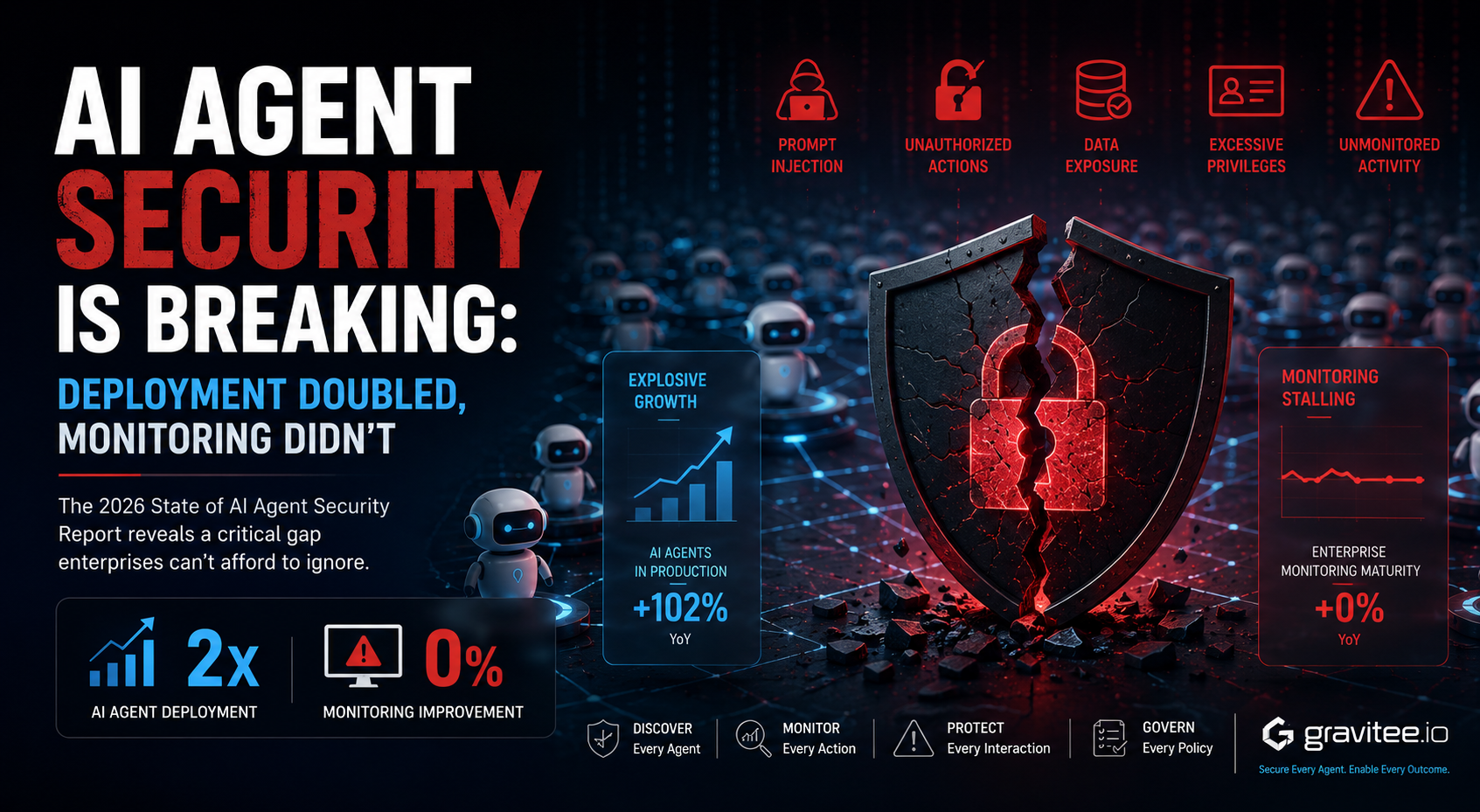
AI Agent Security Is Breaking: Deployment Doubled, Monitoring Did Not
AI agents are moving from pilots into production at enterprise speed, but security controls are not scaling at the same pace. Gravitee’s State of AI Agent Security 2026 report shows a widening gap between adoption, monitoring, accountability, and real operational control.
The Agentic Enterprise Has Arrived
AI agents are no longer theoretical architecture diagrams or innovation lab experiments. They are entering production environments, connecting to APIs, accessing business data, triggering workflows, and acting on behalf of users across enterprise systems. The agentic enterprise is already here, but the security model around it is still catching up.
Gravitee’s State of AI Agent Security 2026 report captures this shift with unusual clarity. Based on a survey of 750 senior technology leaders across the United States and the United Kingdom, the report shows that enterprise AI agent estates have roughly doubled in four months. At the same time, monitoring coverage, pre-deployment controls, and accountability structures have barely advanced.
This is the central tension of the moment. Enterprises are accelerating agent deployment because the business case is compelling. Agents promise productivity, faster execution, better customer experiences, and automation across fragmented systems. But agents also introduce a new kind of attack surface. They are not just software features. They are autonomous or semi-autonomous actors that can make requests, access services, process sensitive information, and interact with other systems.
The Monitoring Gap Is the Real Story
The most important finding in the report is not simply that AI agent adoption is growing. Growth was expected. The more important finding is that security visibility is not keeping pace. Gravitee reports that 90% of organizations have unmonitored agents in production and that the average monitoring coverage is only about 52%. That leaves roughly 48% of production AI agents running without active security or governance coverage.
For enterprise security teams, that number should stand out. A production agent without monitoring is not just an unmanaged application. It is a system that may have delegated authority, access to data, and the ability to act across workflows without consistent observation. In API terms, it may look like a legitimate consumer. In identity terms, it may behave like a user. In operational terms, it may become a hidden pathway for data exposure, policy drift, or unauthorized activity.
The report also highlights a confidence gap. Organizations say they have increasing visibility into agents, but measured monitoring coverage remains limited. That disconnect is dangerous because perceived control can be worse than acknowledged uncertainty. If leaders believe the environment is covered when nearly half the agent estate is unsecured, risk accumulates quietly.
Agents Are Becoming a New Class of User
The security architecture for AI agents requires a new mental model. An agent should not be treated as a background script, a shared service account, or an invisible automation helper. It should be treated as a distinct authenticated actor with scoped permissions, audit trails, rate limits, data boundaries, and lifecycle management.
This is one of the report’s most important technical implications. Agents act on behalf of people, teams, and workflows, but their behavior is not identical to a human user. They may operate continuously, call tools repeatedly, interact with multiple APIs, retrieve context from vector stores, and pass information across systems. That creates identity and access management challenges that traditional user models were not designed to handle.
The enterprise response should be clear. Every agent needs an identity. Every identity needs least-privilege access. Every action needs logging. Every workflow needs a revocation path. Every production deployment needs an owner. This is not optional governance overhead. It is the minimum operating model for agentic systems.
Incidents Are Already Happening
Gravitee’s report states that 54% of organizations have experienced or suspected an AI agent security or data privacy incident in the past 12 months. That figure is significant because it suggests agent risk is no longer hypothetical. It is already showing up inside production environments.
The report identifies several recurring failure patterns. Excessive permissions are one of the most common. Agents are often granted broader access than their actual function requires, sometimes because teams use shared credentials, inherited permissions, or overly permissive API scopes during pilot phases. What begins as a shortcut becomes a production exposure.
Data retention and privacy violations are another recurring pattern. Agents may store prompts, conversation logs, customer information, or sensitive records longer than policy allows. Third-party AI services can further complicate this issue if inputs are logged, cached, or processed outside expected boundaries.
Prompt injection and adversarial manipulation are also becoming more serious. As agents browse websites, read documents, process emails, and interact with external content, they can be influenced by malicious instructions embedded in the data they consume. This turns the agent’s context window into a security boundary, and many organizations are still learning how to defend it.
Pre-Deployment Controls Are Still Too Thin
The report found that only about one in five organizations fully secures and governs agents before they go live. Most organizations say they secure most agents, but not all. That distinction matters. In traditional security, the exception often becomes the breach path. In agent security, the same logic applies.
Pre-deployment governance should include several baseline controls. Security teams need to review the agent’s purpose, data access, API permissions, tool inventory, logging plan, escalation path, and shutdown mechanism. Business teams need to define the scope of allowed behavior. Platform teams need to validate where the agent runs, how it authenticates, and how it is monitored after deployment.
The report notes that no single pre-deployment control is used by even 40% of organizations. That suggests the market is still early in standardizing agent release processes. Many teams are building fast, but their launch gates are not yet mature enough for autonomous software that can access live systems.
Accountability Is the Governance Crisis
Security incidents are hard to manage when no one owns the system. Gravitee reports that only 7.2% of organizations have a named individual formally accountable for AI agent behavior. The majority describe accountability as unclear, shared but undefined, or not yet discussed.
This is not a paperwork problem. It is an operational failure mode. When an agent exposes data, performs an unauthorized action, generates harmful output, or misuses an API, the organization needs to know who is responsible for response, remediation, root cause analysis, and policy updates.
Agent ownership should be explicit before production. The owner does not have to be one person for every domain, but the chain of responsibility must be clear. A mature model may include a business owner, technical owner, security approver, and compliance reviewer. What matters is that accountability exists before the agent has access to real systems.
Speed Is Winning Over Security
The pressure to deploy agents is intense. Gravitee found that 81% of respondents feel pressure to deploy AI agents quickly even when security or governance is not fully in place. The drivers are familiar: productivity, ROI, competitive pressure, board expectations, and the desire to show visible AI progress.
This pressure is understandable. AI agents can create real operational leverage. They can reduce repetitive work, improve response time, automate handoffs, and connect systems that previously required manual coordination. But speed without control creates fragility.
The better path is not to slow AI adoption to a crawl. It is to industrialize the deployment model. Enterprises need agent gateways, policy enforcement, identity controls, observability, approval workflows, and standardized release processes. Moving fast and moving securely are compatible only when the platform layer is designed for both.
The New Security Stack for Agents
Agent security will require a stack that looks different from traditional application security. API security remains critical, but it is not enough. Identity and access management must extend to non-human actors. Observability must track agent behavior in real time. Governance must apply across APIs, events, tools, memory stores, model providers, and agent-to-agent communication.
Enterprises should start by inventorying every agent in production and development. They should classify agents by risk level, data access, tool access, business function, and external exposure. From there, teams can apply least privilege, isolate high-risk workflows, enforce gateway-level policies, and monitor agent actions continuously.
The security goal is not to block agent adoption. The goal is to make agent adoption safe enough to scale. That requires treating agents as infrastructure, not experiments.
Final Perspective
The State of AI Agent Security 2026 report makes one point impossible to ignore. Enterprise AI agents are scaling faster than the controls designed to manage them. Deployment has accelerated. Monitoring has not. Confidence has risen. Coverage remains incomplete. Incidents are already occurring. Accountability is still unclear in most organizations.
For technology leaders, the takeaway is direct. AI agent security is now an execution problem. The risks are known. The missing layer is operational discipline: identity, visibility, ownership, policy enforcement, and continuous monitoring.
The next phase of enterprise AI will not be defined only by who deploys the most agents. It will be defined by who can deploy agents safely, govern them continuously, and prove control at production scale.